Energy Efficient Clustering Protocol for Large-Scale Sensor Networks Abstract? Energy Efficient Clustering Protocol for Large-Scale Sensor Networks. Due to the energy limit of sensor nodes, prolonging lifetime of wireless sensor networks < Final Year Projects 2016 > WSNs is a big challenge.This challenge become even more critical in large-scale sensor networks,in which more energy is…
Energy Efficient Clustering Scheme for Prolonging the Lifetime of Wireless Sensor Network With Isolated Nodes Abstract? A suitable clustering algorithm for grouping sensor nodes can increase the energy ef?ciency of WSNs. However, clustering requires additional overhead, such as cluster head selection and assignment, and cluster construction. This paper proposes a new regional energy aware clustering…
Energy-Aware Interconnect Resource Reduction Through Buffer Access Manipulation for Data-Centric Applications Abstract? Energy-Aware Interconnect Resource Reduction Through Buffer Access Manipulation for Data-Centric Applications.This paper presents a methodology for reducing interconnect resources in reconfigurable platforms such as field-programmable gate arrays (FPGAs). This methodology utilizes the techniques developed for the buffer-based dataflow, a new design representation suitable…
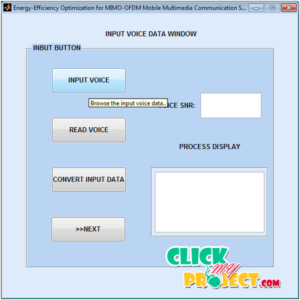
Energy-Efficiency Optimization for MIMO-OFDM Mobile Multimedia Communication Systems With QoS Constraints Energy-Efficiency Optimization for MIMO-OFDM Mobile Multimedia Communication Systems With QoS Constraints. It is widely recognized that, in addition to the quality-of-service (QoS), energy efficiency is also a key parameter in designing and evaluating mobile multimedia communication systems, which has catalyzed great interest in recent…
Energy-Efficient Cluster-Head Rotation in Beacon-Enabled IEEE 802.15.4 Networks Abstract? Energy-Efficient Cluster-Head Rotation in Beacon-Enabled IEEE 802.15.4 Networks. Wireless sensor networks that use slotted, beacon-enabled IEEE 802.15.4 standard are often implemented using clustering with randomized sleep of < Final Year Projects 2016 > nodes to extend the network lifetime. To reduce the imbalance of power consumption…
Energy-Efficient Configuration of spatial and frequency Resources in MIMO_OFDMA Systems Abstract?we investigate adaptive configuration of spatial and frequency resources to maximize energy efficiency (EE) and reveal the relationship between the EE and the spectral efficiency (SE) in downlink multiple-input-multiple-output (MIMO) orthogonal frequency division multiple access (OFDMA) systems. We formulate the problem as minimizing the total…
Energy-Efficient Fault-Tolerant Data Storage and Processing in Mobile Cloud Abstract?Despite the advances in hardware for hand-held mobile devices, resource-intensive applications < Final Year Projects 2016 > e.g., video and image storage and processing or map-reduce type still remain off bounds since they require large computation and storage capabilities. Recent research has attempted to address these…
Energy-efficient orthogonal frequency division multiplexing scheme based on time?frequency joint channel estimation ISSN 1751-8628 Abstract? Time-domain synchronous orthogonal frequency division multiplexing (TDS-OFDM) enjoys the higher spectrum ef?ciency and faster synchronization than the classical cyclic pre?x OFDM (CP-OFDM). However, TDS-OFDM suffers from performance degradation especially under severely fading channels with long delays. To solve these problems,…
Enhanced Re-coloring Method with an Information Preserving Property for Color-Blind Person Abstract? Various image re-coloring methods have been developed to enhance the perceptibility of the image for the color-blind. Recently, some methods have been proposed to produce the re-colored images that are not only visually perceptible for color deficient viewers but also look natural for…
Enhancement of Textural Differences Based on Morphological Component Analysis Abstract? Enhancement of Textural Differences Based on Morphological Component Analysis. A new texture enhancement method which uses an image decomposition that allows different visual characteristics of textures to be represented by separate components in contrast with previous methods which either enhance texture indirectly or represent all…
Enhancing Security and Privacy for Identity-based Batch Verification Scheme in VANET Abstract? Vehicular ad hoc network (VANET) can significantly improve the traffic safety and efficiency. The basic idea is to allow vehicles to send traffic information to roadside units (RSUs) or other vehicles. Vehicles have to be prevented from some attacks on their privacy and…

 Free
Free