Free
Free 
Introduction
Selecting the right project is one of the most important decisions for engineering graduates, especially computer science and information technology students. The final year project is not only an academic requirement; it is also a significant indicator of the student’s technical skills, analytical skills, and ability to tackle real-world problems of the IT industry. Considering the numerous programming technologies available today, Java Projects For final year students remain the most preferred option among the academic fraternity, professors, and recruiters.
Java is one of the programming languages that has been able to pass the test of time due to its robust nature, scalability, security, and wide acceptance in the field of enterprise-level programming. Java is the backbone of many real-world applications, including banking systems, healthcare systems, e-commerce sites, and internal corporate applications.
Classic management systems are evergreen project ideas because they solve real-world operational problems faced by institutions such as colleges, hospitals, libraries, hotels, gyms, and corporate organizations. These systems help students understand how software solutions are planned, designed, developed, tested, deployed, and maintained in real environments. From database handling and backend business logic to authentication, authorization, and role-based access control, such projects cover the complete software development lifecycle.
In this detailed and elaborated blog, we explore Java Projects For final year students under the category of Classic Management Systems. Each project idea is explained comprehensively, including its objectives, real-world relevance, core features, system modules, learning outcomes, and future enhancement possibilities. This guide is specifically designed to help students confidently select a Java-based final year project that not only satisfies academic expectations but also significantly improves employability and interview performance.
Why Choose Java Projects For Final Year Students?
Before exploring individual project descriptions, it is essential to understand why Java continues to dominate the Java Projects For Final Year ecosystem year after year.
Platform Independence
Java applications can run on any operating system that supports the Java Virtual Machine (JVM). This platform independence makes Java projects flexible, portable, and easy to deploy across different environments without code modification.
Strong Industry Demand
Java is extensively used in domains such as banking, healthcare, insurance, e-commerce, ERP systems, education platforms, and enterprise software. Recruiters actively seek candidates with strong Java project exposure, making Java Projects For final year students highly valuable for placements.
Object-Oriented Design Principles
Java strictly follows object-oriented programming concepts such as abstraction, inheritance, encapsulation, and polymorphism. These principles encourage clean architecture, modular development, code reusability, and long-term maintainability.
Robust Framework Ecosystem
Java offers a powerful ecosystem of frameworks and tools such as Spring, Spring Boot, Hibernate, JSP, Servlets, and JDBC. These technologies simplify enterprise-level application development and prepare students for professional software environments.
Seamless Database Integration
Java integrates smoothly with relational databases like MySQL, PostgreSQL, Oracle, and SQL Server. This allows students to build data-driven applications with strong backend support.
Because of these advantages, Java Projects For final year students remain relevant regardless of changing technology trends.
Overview of the Selected Projects
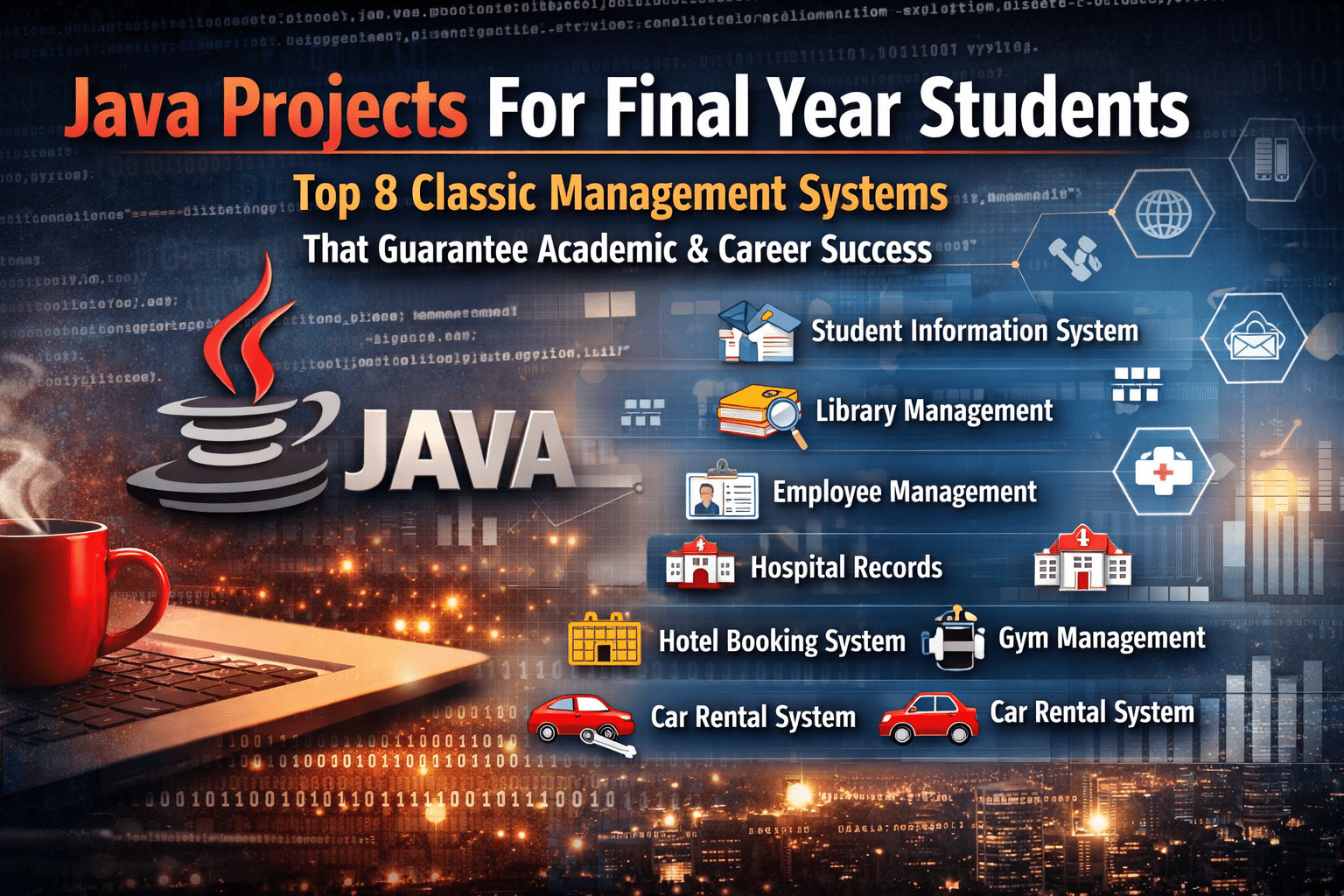
In this blog, we present 8 powerful and carefully selected Java Projects For final year students, each designed with a strong problem statement, clear objectives, detailed functionality, and significant scope for future enhancement. These projects are academically robust and create a lasting impression during project reviews, viva examinations, and technical interviews.
1. Smart Student Information & Academic Management Syste
Project Description
The Smart Student Information & Academic Management System is one of the most impactful Java Projects For final year students, as it directly relates to the academic environment. This project focuses on digitizing and automating student-related data management processes that are traditionally handled manually.
The system maintains complete student profiles, course registrations, academic performance records, attendance details, and semester-wise grade reports within a centralized database. By eliminating paperwork and manual record-keeping, the system improves efficiency, accuracy, and transparency.
Multiple user roles are supported, including administrator, faculty, and students. Administrators are responsible for managing departments, courses, and user accounts. Faculty members upload attendance and marks, while students can view their academic progress, enrolled courses, and performance analytics in real time.
Key Functionalities
- Student registration and profile management
- Course creation, allocation, and enrollment handling
- Faculty-based attendance and grade entry system
- Automated semester-wise result generation
- Secure role-based authentication and authorization
Learning Outcomes
This project strengthens understanding of database design, normalization, access control mechanisms, MVC architecture, and academic reporting systems. It is one of the most preferred Java Projects For final year students in universities due to its practical relevance.
Future Enhancements
- Integration with online learning platforms
- Performance analytics dashboards
- Mobile application support
- Cloud-based deployment
2. Advanced Library Management System with Automated Fine Engine
Project Description
The Advanced Library Management System modernizes traditional library operations by introducing automation and intelligent tracking mechanisms. As a classic choice among Java Projects For final year students, it focuses on managing book inventories, member records, issue and return transactions, and fine calculations.
The system automatically calculates fines based on predefined due dates and actual return dates, significantly reducing human errors. Advanced search functionality enables users to locate books using title, author name, category, or ISBN number.
Key Functionalities
- Digital book catalog management
- Member registration and access control
- Issue and return transaction tracking
- Automated fine calculation engine
- Real-time book availability status
Learning Outcomes
Students gain hands-on experience with CRUD operations, date-based business logic, transaction management, and database optimization techniques.
Future Enhancements
- Barcode or QR code integration
- E-book management module
- Email and notification alerts
3. Enterprise Employee Management System with Leave & Role Control
Project Description
The Enterprise Employee Management System simulates real-world corporate HR software. It is one of the most industry-oriented Java Projects For final year students, designed to manage employee information, organizational structure, leave workflows, and role-based permissions.
Employees can apply for leave online, managers can approve or reject requests, and HR administrators can monitor attendance and employee performance. The system ensures secure access by defining roles such as admin, manager, and employee.
Key Functionalities
- Employee profile and department management
- Online leave application and approval workflow
- Role-based access control system
- Attendance and employment status tracking
Learning Outcomes
This project helps students understand enterprise authentication, authorization, workflow automation, and secure data handling practices.
Future Enhancements
- Payroll processing module
- Performance evaluation system
- Integration with biometric attendance
4. Intelligent Hospital Patient Records & Appointment System
Project Description
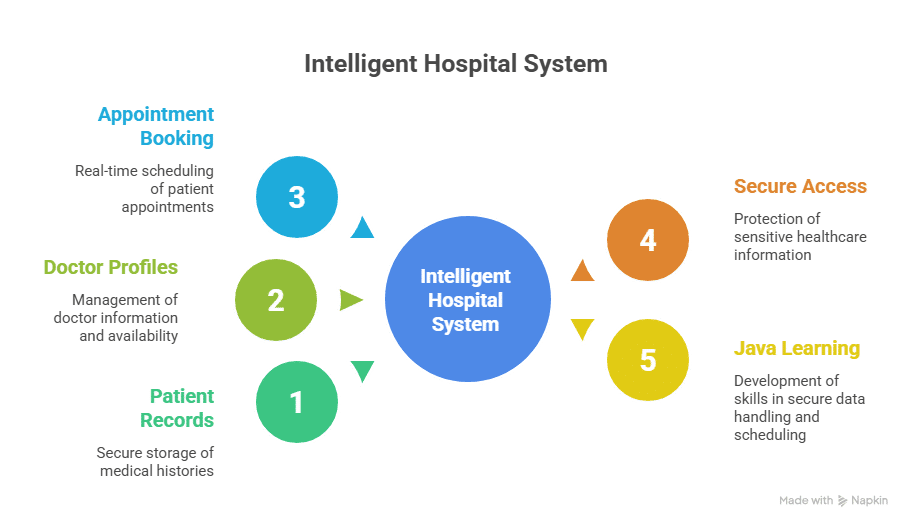
Healthcare applications demand accuracy, efficiency, and high-level security. The Intelligent Hospital Patient Records & Appointment System is one of the most meaningful Java Projects For final year students, focusing on patient data management and appointment scheduling.
The system securely stores patient medical histories, doctor profiles, and appointment schedules. Patients can book appointments based on real-time doctor availability, while doctors can access patient records for better diagnosis and treatment planning.
Key Functionalities
- Patient registration and electronic medical records
- Doctor profile and availability management
- Online appointment booking system
- Secure access to sensitive healthcare information
Learning Outcomes
Students learn secure data handling, access control implementation, and real-time scheduling logic using Java.
Future Enhancements
- Online prescription management
- Integration with laboratory systems
- Telemedicine features
5. Web-Based Smart Contact Management System
Project Description
The Smart Contact Management System is a lightweight yet powerful application among Java Projects For final year students. It allows users to store, organize, categorize, and retrieve contact information efficiently using advanced filtering and grouping techniques.
Compared to traditional contact books, this system offers better organization, faster searching, and secure data access through user authentication.
Key Functionalities
- Contact creation, editing, and deletion
- Grouping, tagging, and categorization
- Advanced search and filter options
- Secure user login and access control
Learning Outcomes
This project improves understanding of efficient data indexing, search optimization, and clean user interface design.
Future Enhancements
- Cloud contact synchronization
- Import/export functionality
- Mobile-friendly UI
6. Real-Time Hotel Room Booking & Management System
Project Description
The Hotel Room Booking & Management System replicates real-world hotel reservation platforms. As one of the most commercially relevant Java Projects For final year students, it focuses on room inventory management, customer bookings, billing, and cancellations.
The system updates room availability in real time and generates invoices automatically after successful bookings, ensuring accurate transaction handling.
Key Functionalities
- Room inventory and category management
- Real-time room availability checking
- Online booking and cancellation
- Automated billing and invoice generation
Learning Outcomes
Students gain experience in transactional systems, concurrency handling, and real-time database updates.
Future Enhancements
- Online payment gateway integration
- Customer feedback and rating system
- Multi-branch hotel support
7. Gym Membership & Trainer Scheduling Management System
Project Description
The Gym Membership & Trainer Scheduling Management System is a modern business-oriented application under Java Projects For final year students. It manages member subscriptions, attendance tracking, trainer schedules, and membership renewals.
Gym administrators can monitor active memberships, assign trainers to members, and analyze attendance trends to improve service quality.
Key Functionalities
- Member registration and subscription plans
- Daily attendance tracking
- Trainer allocation and scheduling
- Membership renewal and expiry alerts
Learning Outcomes
This project strengthens skills in subscription-based systems, scheduling algorithms, and analytical reporting.
Future Enhancements
- Fitness progress tracking
- Diet plan recommendations
- Mobile app integration
8. Smart Car Rental Management System with Fleet Tracking
Project Description
The Smart Car Rental Management System is a business-driven application that automates vehicle rentals and fleet management. It is one of the most practical Java Projects For final year students, closely aligned with real-world rental service operations.
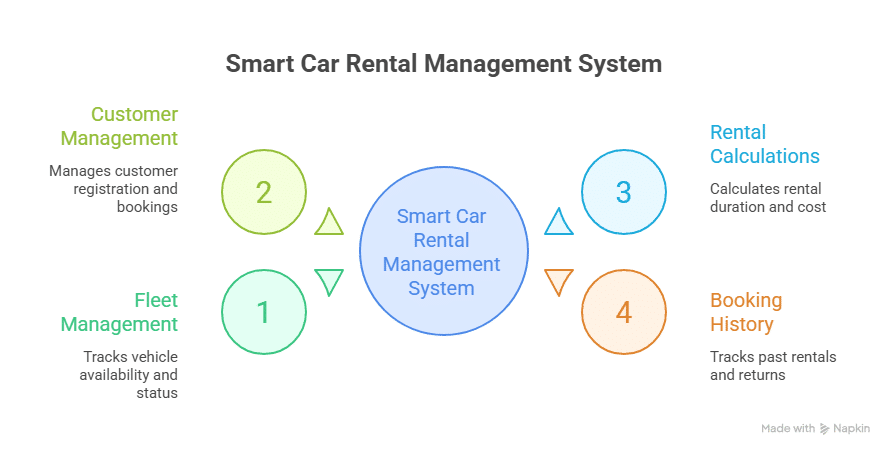
The system manages vehicle availability, customer bookings, rental durations, return status, and payment calculations through a centralized platform.
Key Functionalities
- Fleet and vehicle status management
- Customer registration and booking system
- Rental duration and cost calculation
- Booking history and return tracking
Learning Outcomes
Students learn business logic implementation, data validation techniques, and transactional consistency using Java.
Future Enhancements
- GPS-based vehicle tracking
- Online payment integration
- Dynamic pricing models
Conclusion
These powerful classic management systems clearly explain the significance of Java Projects For final year students as the best option for achieving academic excellence and career success. Each of the projects discussed above helps in solving real-world problems while enhancing the understanding of Java programming, database integration, and software architecture.
Students opting for such projects would be more confident during the project review process, perform better in the examination, and possess better technical skills for appearing in the interview process. MyProjectBazaar helps students in converting the concepts into fully developed projects with complete documentation and technical support.
Frequently Asked Questions (FAQs)
Q1. Why are Java Projects For final year students highly recommended?
Java is widely used in enterprise and mission-critical applications, making Java-based projects highly valuable for both academic evaluation and placement opportunities.
Q2. Are these projects suitable for university submission?
Yes. All the projects discussed meet academic standards and demonstrate strong practical and technical depth.
Q3. Can these projects be further enhanced?
Absolutely. Advanced features such as cloud deployment, enhanced security, analytics dashboards, and API integration can be added.
Q4. Which project is best for job interviews?
Employee Management, Hospital Management, and Hotel Booking systems are particularly impressive during technical interviews.
Q5. Where can students get complete project implementation support?
Students can refer to trusted academic project platforms such as MyProjectBazaar for complete guidance, source code, and documentation support.